
Live illustration for neurodiversity & education events
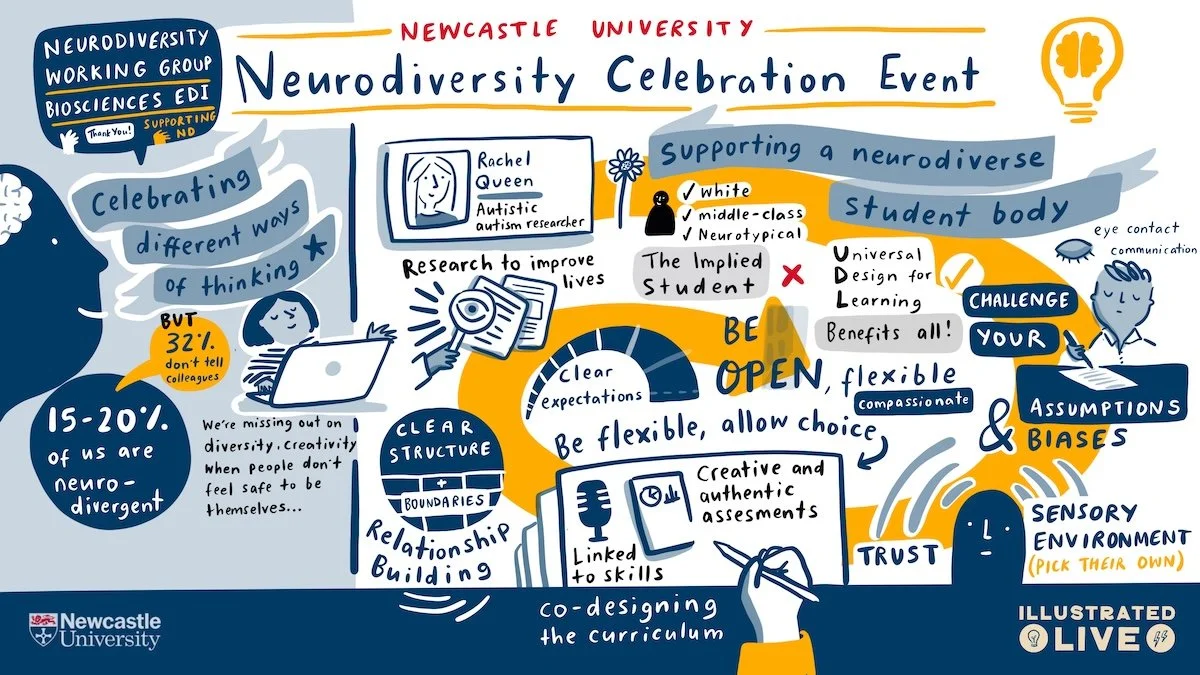
Live illustration from Newcastle University's Neurodiversity Celebration Event.
I’ve live illustrated at lots of events - and this post is specifically about live illustration for neurodiversity, SEND, ASN, ADHD, autism, children’s education, workplace inclusion and how we build better systems for different kinds of brains.
Which sounds nice and neat and tidy when I write it like that.
Howeverrr, these conversations are often big, emotional, complex, and full of acronyms. 😅 There are so many people - internal and external - trying to make sense of how things are working now, and how they could work better.
My job at these events (any events!) is not to be an expert.
My job is to listen carefully, notice any key points and/or patterns, and turn it all into a visual summary people can understand, remember and share afterwards.
Live! While you’re watching!
No pressure, eh?
In case we haven’t met before, hello. I’m Katie Chappell. I’m a live event illustrator and I’ve been doing this graphic recording thing for over a decade now and I blimmin’ love it. As a late-diagnosed ADHD person with neurodivergent friends and family, I have a soft spot for events about neurodiversity.
Here’s some stuff that I’ve I learned from creating visual notes at events about neurodiversity.
Neurodiversity is finally getting the spotlight it should’ve had YEARS ago - hooray!
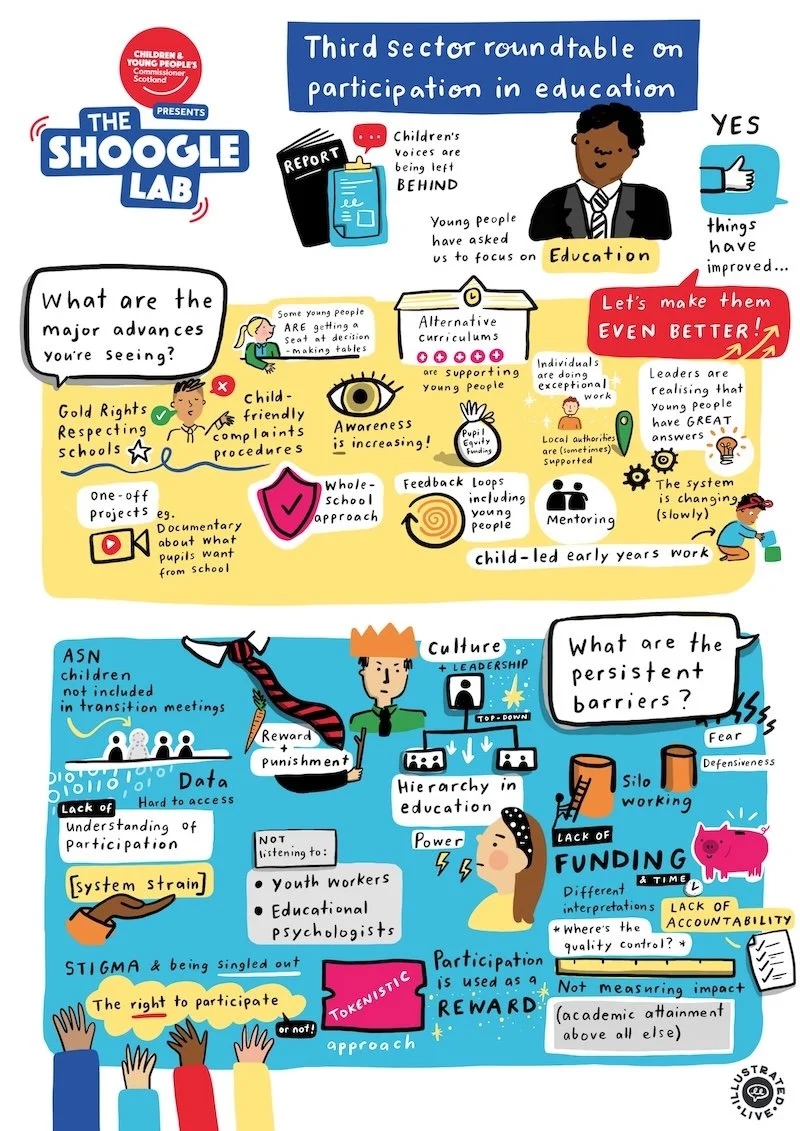
Graphic recording from a third sector roundtable on participation in education.
The Children and Young People’s Commissioner Scotland hired me for 2 of their Edinburgh events. My job was the summarise everything the grownups were saying, so that they could bring that feedback to children in a way that was mega engaging and interesting.
The best conversations are about sharing what works
One of the biggest themes I see at neurodiversity, SEND and education events is the need for people to share best practice.
“This is messy, but this bit helped, and maybe it could help you too” = the most successful way of sharing. (In my humble not-an-expert, just-observing opinion).
I often hear people talking about the importance of networking across schools, services and organisations, sharing practical examples, continuous training, better information-sharing, learning directly from families and young people, and making sure support does not depend on one brilliant person holding everything together.
Because sooo much good work is already happening.
The problem is that it can be very scattered or hidden.
Events are great at showcasing what you’ve been working so hard on!
And live illustration can help capture it in a way that people can come back to. Or in Children and Young People’s Commissioner Scotland’s case - deliver information in a way that young people will be EXCITED to look at.
Works much more nicely than letting all those useful insights disappear into a notebook, a slide deck, or a vague “errr, I think someone said something v brilliant just before lunch?”
Children and young people need to be part of the conversation
One of the strongest messages I’ve heard at these events is: nothing about us without us.
That phrase comes up a lot in disability, inclusion and neurodiversity spaces, and for good reason.
If we’re talking about children and young people’s education, support, transitions, wellbeing and futures, they need to be included in the conversation in meaningful ways.
No ticky box exercises.
Properly included.
I’ve illustrated conversations where young people have asked for better education systems, more thoughtful support, and to be included in key moments like transition meetings.
One of the most briliant things I drew at was about making the future of technology safe for children. They asked children and young people what they wanted and the young people DID NOT want to be left to roam freely around online. They wanted some boundaries and protection.
That really restored my faith in humanity/the future.
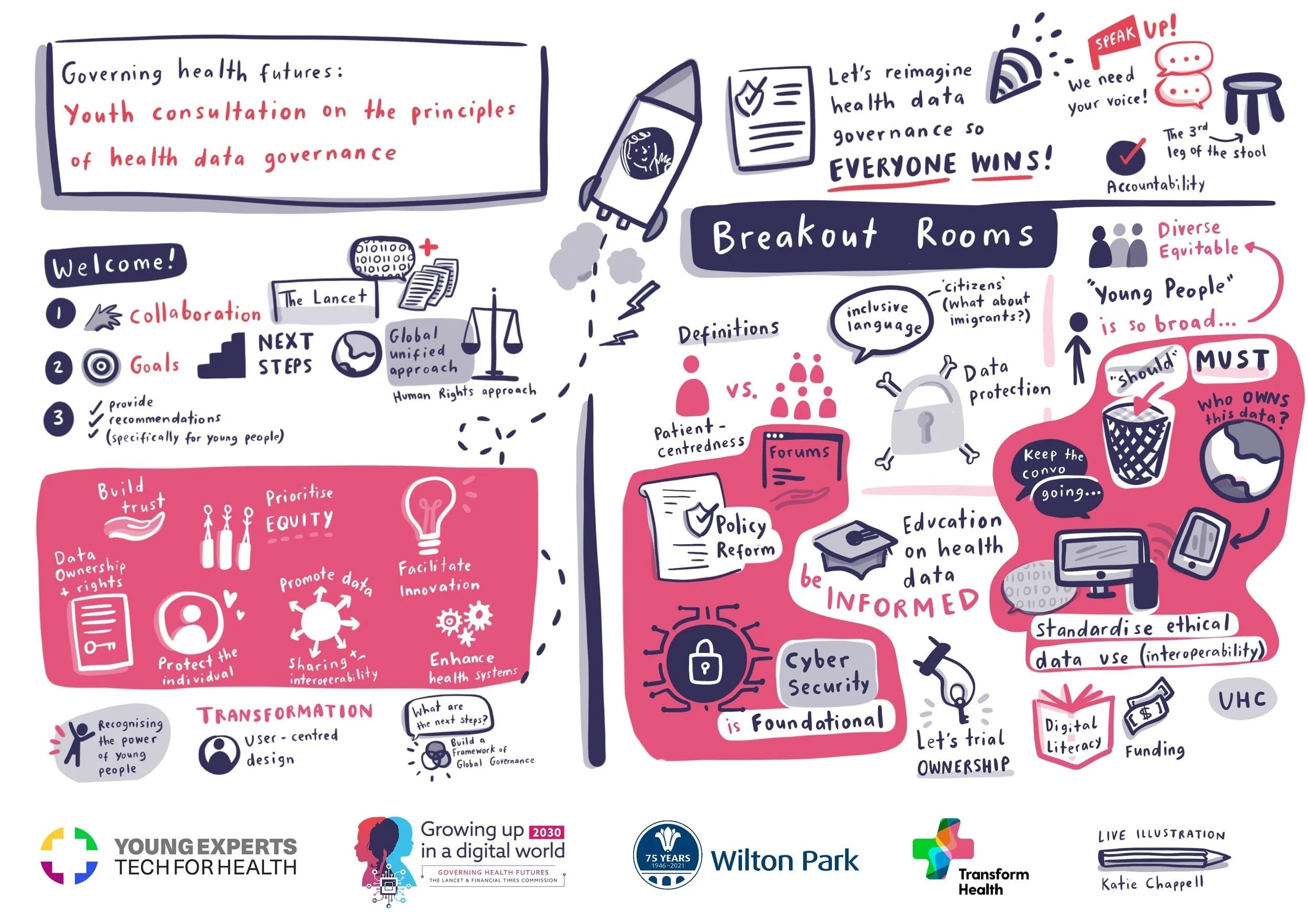
Elements were taken from this live illustration of a consultation with young people, and used in their report / in the Lancet Journal.
Because from the outside, systems can become very adult-heavy. Lots of professionals talking to other professionals about what children need.
But children and young people are often telling us incredibly clearly what is not working, what helps, what makes them feel safe, and what needs to change.
We just have to listen properly.
Neurodivergent thinking is valuable
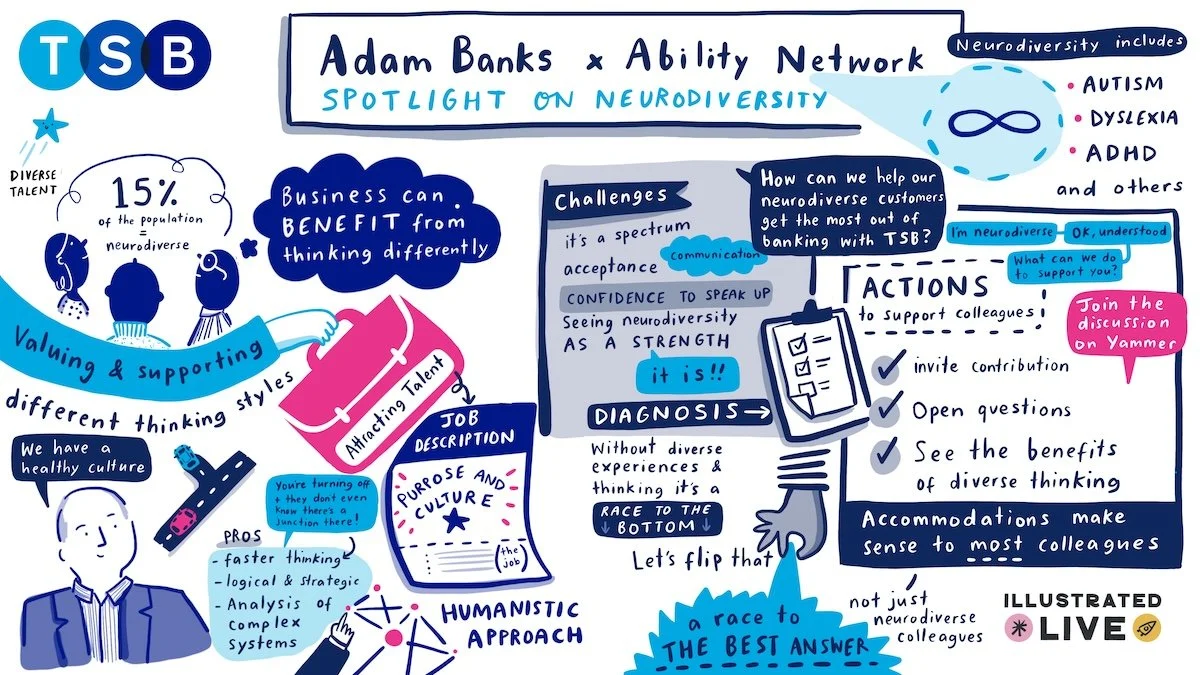
Live illustration for TSB x Ability Network's Spotlight on Neurodiversity session.
But duhh, you’re reading this so you knew that already.
One of the moments that has really stayed with me was live scribing at an event where Adam Banks spoke openly about having ADHD and autism at an online event I was live scribing at for TSB.
He talked about his work as a director and advisor for huge companies, including complex platform businesses with enormous budgets, and he spoke about his neurodivergence as something that was part of the value he brings.
His attitude was: “this is part of how I think, notice, solve problems and contribute.”
I loved that.
Partly because I have ADHD myself, and I’m a very visual thinker. So obvs I am completely biased here. I work with lots of neurodivergent artists and creatives, and I get to see every day how powerful different ways of thinking can be.
BUT, I also think this is something schools and society need to understand much earlier.
Neurodivergent children are not failed neurotypical children.
They may need support. They may need adjustments and advocacy. But accommodations help everyone. Wait, that’s good enough to be a heading.
Accommodations often help everyone!
Another thing I hear a lot in conversations about neurodiversity is that accommodations are not just useful for neurodivergent people.
Clear communication helps everyone!
Quiet spaces help more people than you think.
Flexible ways to participate help everyone who is tired, anxious, overwhelmed, processing, caring for someone, dealing with health stuff, or simply having a very human day.
Visual summaries help people who think in pictures, people who were not in the room, people who need to revisit information, and people who struggle to take in a wall of text at speed.
When we design with neurodivergent people in mind, we often make things better for everyone.
And yes, I’m biased.
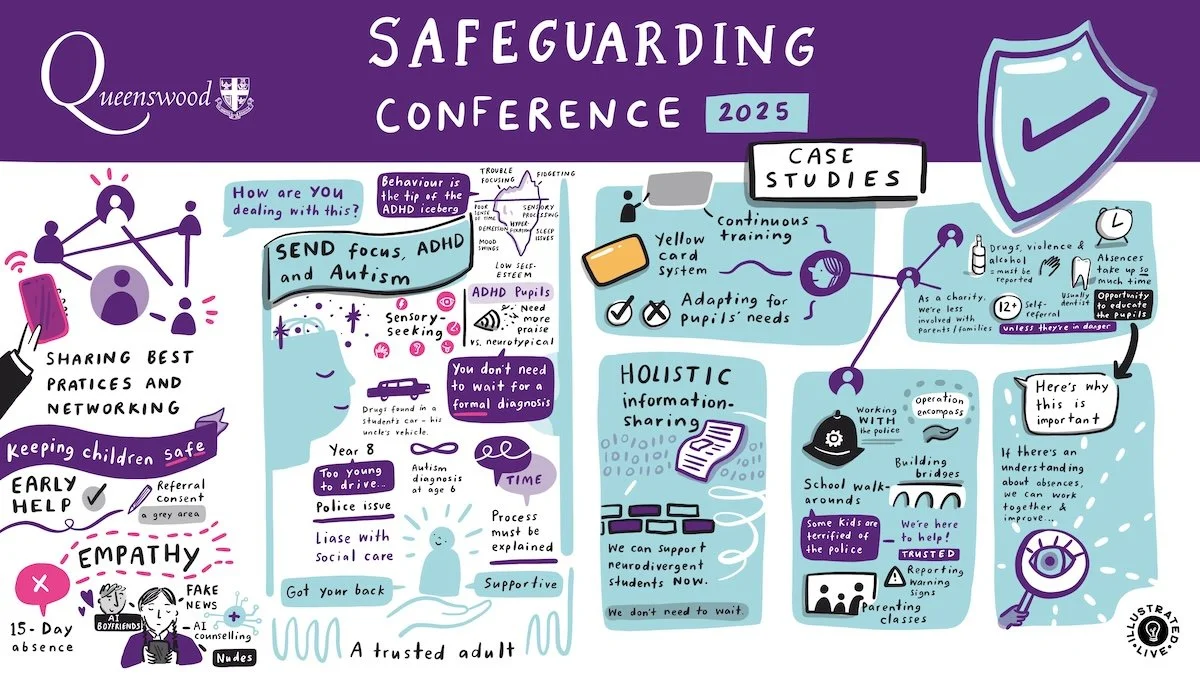
Visual notes from Queenswood's Safeguarding Conference, covering SEND, ADHD and autism.
How does live illustration work at an education conference?
If you’ve never booked a live illustrator before, you might be wondering what it actually looks like on the day.
Good question.
I’ve done my best to document the live illustration process here.
Most people have seen keynote speakers, panels, breakout rooms and conference photographers before. Live illustration is often the bit where people go, “Ooooh, what’s that?”
For digital live illustration, I draw on an iPad while the event is happening. That can be shown on a big screen in the venue, brought up during breaks as a recap, kept as a surprise for the end of the day, or shared afterwards in a “thank you for coming” email. (Or all of the above!)
There are a few different ways to use it.
Some organisers want one big visual summary of the whole event. A proper one-page “ta-da, this is what we talked about” piece.
Others want a visual page per keynote, panel or breakout theme, so there’s more detail to use afterwards.
For events with lots of breakout sessions happening at the same time, we can plan the best approach in advance. Sometimes I’ll focus on one room in detail. Sometimes I’ll move between sessions and capture the overall themes. Sometimes organisers use note-takers in each room, and I pull out the key points from their notes afterwards so every session is represented.
It depends on the purpose of the event.
Do you want…
a big memorable visual takeaway?
a detailed record of each session?
social media content afterwards?
something for internal comms, a report, a funder update or a stakeholder pack?
We can hop on a call and figure all that stuff out wayyy before the event.
What if the content is dense, technical or a bit difficult to visualise?
This comes up a lot.
Education, SEND and neurodiversity events can involve a lot of detailed information. Policy. Research. Funding. Pathways. Acronyms. Strategic priorities. Safeguarding. Data. Frameworks. Lots of very important words that do not immediately scream “please draw me as a jaunty little picture.”
But that is where live illustration is useful.
The aim is not to document every single slide or turn every policy detail into a cartoon.
The aim is to listen for the human story, the useful pattern, the memorable phrase, the shift in thinking, the practical takeaway.
A dense slide deck already exists as a dense slide deck.
The visual summary helps people understand the key points and the important bits.
Can live illustration work with our brand?
Yep!
Before the event, I send a short pre-event questionnaire asking for useful bits like your agenda, timings, logo, brand colours, preferred title, key acronyms, names, and anything politically or culturally sensitive that I should know about.
The more useful context I have before the day, the better I can make the illustration feel like it belongs to your event.
What about awards, celebrations and leadership days?
Live illustration works especially well when there is a story to capture.
So if your event includes an awards ceremony, celebration section or leadership day, it is worth thinking about the content around it.
A simple list of winners can be lovely in the room, but visually it can become a bit “name, name, name, name, ta-da.”
Where it becomes more interesting is when there are stories behind the awards. What did this person or team do? What changed? Who did it help? What does this show about your values?
That is the good stuff.
That is where visual storytelling can help people remember not just who won, but why it mattered.
What do you get after the event?
With digital live illustration, you get the final image files to use afterwards.
You also usually get a timelapse animation showing the illustration building up, which can be a lovely ready-made piece of content for LinkedIn, internal comms, follow-up emails or event round-ups.
This is one of the things marketing and comms teams tend to love. It’s also a lovely boost if you have sponsors at your event that you’d like to spoil rotten. I’ve written a bit more on how to give your event sponsors real value here.
Because instead of the event ending and everyone thinking, “Right, now we need to somehow turn that enormous day into content,” you already have a visual record ready to share.
BOOM. Done. Next problem.
Why live illustration helps at neurodiversity and SEND events
Live illustration is useful for lots of complex conversations, but it feels especially relevant at events about neurodiversity, SEND and education.
These events often involve big ideas, emotional topics, lots of different stakeholders and a huge amount of information.
A live illustrated visual summary can help by making key messages easier to absorb quickly, turning complex conversations into something people can see, helping important points stand out, creating a useful takeaway after the event, helping the conversation reach people who were not in the room, supporting visual thinkers and mixed audiences, and giving organisers something memorable to share in reports, slides, social posts and internal comms.
And because the illustration is created live, people can see the conversation taking shape as it happens.
That can be really powerful.
It shows people that their words are being heard.
It helps the room see the bigger picture.
And it gives the event a shared visual record that you can show off a bit on LinkedIn.
Planning live illustration for neurodiversity, SEND or education event?
If you’re organising a conference, panel, training day, stakeholder event or internal session about neurodiversity, SEND, ASN, ADHD, autism, education or inclusion, live illustration can help make the conversation clearer, more memorable and easier to share.
I work remotely, which means I can dial into online, hybrid and in-person events without needing to travel.
I listen in live, capture the key themes, and create digital visual notes that can be shared after the event with attendees, teams, funders, families, young people, stakeholders or wider communities.
It’d be lovely to work with you.
x Katie